
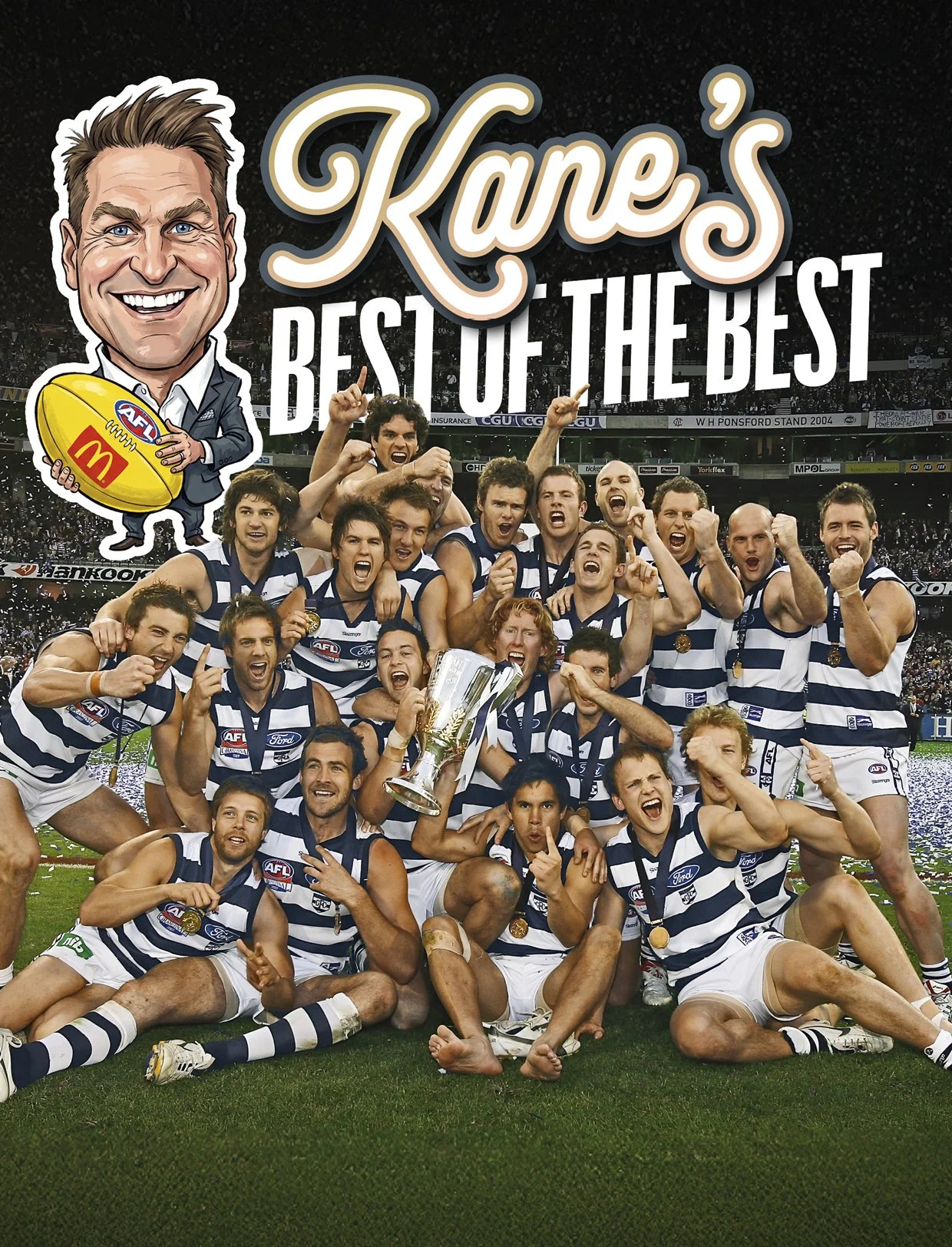
SEN and Channel Seven’s KANE CORNES has ranked every premiership team since 2000. These rankings are based on who he believes had the best list, the best group of players and the best team. On brand for him, romantic storylines and the fairytale nature of some of these Grand Final triumphs have not been considered.
1. GEELONG 2007
I think this is the best team this century.
They had nine All-Australians – Gary Ablett, Jimmy Bartel, Joel Corey, Matty Egan, Stevie Johnson, Cameron Ling, Darren Milburn, Cam Mooney and Matt Scarlett – and Mark Thompson was the coach.
They smashed teams in the finals; they beat North Melbourne by 106 in the qualifying final; they got through in a tight preliminary final against Collingwood and then smashed Port Adelaide by a record Grand Final margin (119 points).
I’m not sure a team will win two of their three finals by more than 100 points ever again.
These Cats had guns everywhere, and this was the best team, headlined by their group of nine All-Australians.
2. BRISBANE LIONS 2002
The Lions defeated Collingwood by nine points in one of the most brutal wet weather Grand Finals you’ve ever seen.
They had five All-Australians – Jason Akermanis, Simon Black, Chris Johnson, Nigel Lappin and Michael Voss.
This was an unbelievable team and the best of the Lions’ three-peat premiership teams of this era.
If you put this group up against the 2000 Essendon team, the Lions win if all things are equal.
This midfield group led by the ‘Fab Four’ – Voss, Black, Akermanis and Lappin – and the forward line of Jonathan Brown, Daniel Bradshaw and Alastair Lynch, together with all the smalls running around and their goalkicking midfielders, was freakish.
They have just been nudged out by the 2007 Geelong group.
3. ESSENDON 2000
Only the third-best premiership team this century, and some are going to be unhappy with this.
The Bombers set the record for the most consecutive wins in a single season with 20; they won the pre-season cup, the minor premiership and the premiership.
Their average winning margin was 51 points, they had four All-Australians – Dustin Fletcher, Damien Hardwick, James Hird and Matthew Lloyd – and ‘Sheeds’ (Kevin Sheedy), the legend, was named coach of the year.
But I deducted points because while this exercise was based on a season’s work, I had to split them somehow, so the teams that won more than one flag in that era got extra points.
Was there just a weakness in the midfield for this group? Perhaps when you compare the other midfields to the others at the top.
Joe Misiti, Chris Heffernan, Justin Blumfield and Jason Johnson – is that as good?
If this group went up against
the next teams on this list, who would win?
I think they’d get sorted out in the midfield, perhaps not obliterated.
But they were tough, they were hard, they were intimidating.
They’re the third-best team this century, so it’s pretty good, but they just couldn’t capitalise their dominance and parlay this one win into two, three or even four flags.
4. GEELONG 2009
This was difficult.
This was maybe one of the most stacked teams you’ve ever seen.
They had five All-Australians – Corey Enright, Joel Selwood, Paul Chapman, Matthew Scarlett and Gary Ablett – and had three other players nominated.
This team measures up against anyone. Where is the weakness in this team?
I’ve got them at four and it might be the most stacked team there is.
It’s a very good team but there is one Geelong team (2007) that I think is better.
5. BRISBANE LIONS 2001
This was the team that knocked off an Essendon line-up which had only lost two games in two years.
If it bleeds you can kill it.
The Lions went on a 16-game winning streak and had four All-Australians.
The ‘Fab Four’ absolutely arrived – Jason Akermanis, Michael Voss, Simon Black and Nigel Lappin.
It was Jonathan Brown’s second season and he was so crucial to how they structured up with his physicality.
Just a tough, angry, hard and brilliant team.
6. HAWTHORN 2013
This was a powerful unit.
The thing I loved about this team was the motivation they had from 2012 (losing to Sydney). You hear all the players from this team speak about how much 2012 hurt, and how they wanted to make a statement.
Just two All-Australians that year – Sam Mitchell and Jarryd Roughead. Some were overlooked, or maybe that’s just a sign of how even they were.
It’s a very good team and six is pretty high out of 26 teams.
7. BRISBANE LIONS 2003
This was the weakest of the three-peat, but it is incredible to think an interstate team with that travel and workload won three flags in a row.
This was a team that was wounded and banged up – Nigel Lappin, Alastair Lynch and Jonathan Brown were starting to feel the effects of the way they played and the long campaigns they’d been through.
In my research, I read that coach Leigh Matthews said in that Grand Final the club’s medicos used 18 vials of painkillers.
Whether that’s myth or fact, I don’t know, but it makes sense.
They won on pure grit, toughness and experience, with three All-Australians – Justin Leppitsch, Michael Voss and Lappin.
Of the three of their premiership teams, this was the weakest.
8. HAWTHORN 2015
These Hawks lost the first final to West Coast by 32 points before turning the tables from there to win the premiership.
They had three All-Australians – Josh Gibson, Cyril Rioli and Sam Mitchell – and stars everywhere.
When you win three in a row you’ve got be right up there.
I’m sure some people would have had this team higher.
Great players everywhere – Jarryd Roughead, Luke Hodge, Shaun Burgoyne, Gibson, and some big-time performers such as Rioli.
Brad Hill was a good player; Grant Birchall was a good player.
The all-conquering Hawks at eight. To win three in a row is almost impossible.
9. WEST COAST 2006
This team had four All-Australians – Darren Glass, Ben Cousins, Chris Judd and Dean Cox and the latter three were all-time champions.
The Eagles won six games by 10 points or less, and gee they had some good players – Glass was a good player and Daniel Kerr a gun.
I really liked this team, they were well balanced with good role players like Adam Selwood and Rowan Jones; Michael Braun and Chad Fletcher were good players, David Wirrpanda was a very good player, Tyson Stenglein played an important defensive role through the midfield and Andrew Embley, won the Norm Smith Medal on the wing.
This ranking is perhaps a little bit higher than some would have had them, but for the star factor and the all-time greats they had – and that destructive midfield – they come in at nine.
10. HAWTHORN 2014
This has a little bit of bias to it because we (Port Adelaide) played them in the preliminary final that year.
We kicked 3.9 in the first quarter, and they won by three points.
I thought they were beatable – as good as they were, I thought they had a few chinks in their armour.
They won four games by under 10 points, so they were the kings of the close finish.
They had three All-Australians – Jordan Lewis, Luke Breust and Jarryd Roughead, who had an unbelievable year without ‘Buddy’ (Lance Franklin), kicking 75 goals.
The way they were able to handle Franklin’s exit brings extra points.
It was the year ‘Clarko’ (Alastair Clarkson) had a bit of a health crisis, so there was the maturity of the team being able to handle the coach missing for five games.
They were the highest scoring team in the League and get extra points for going back-to-back because it’s so hard to do.
11. RICHMOND 2019
I think this was the best of the three (Tiger flags). They absolutely smashed teams in the finals – the Lions in the qualifying final by 47, Geelong by 19 in the prelim and that disastrous Grand Final day for the Giants.
Dylan Grimes and Bachar Houli were the only Tigers to make the All-Australian team in 2019, but they finished the season winning 12 in a row, really kicking into gear when the business end came.
What a fantastic team they were over several years, but I think this was the best of them – Trent Cotchin, Tom Lynch and Jack Riewoldt all in their prime.
Nick Vlastuin and Houli both had an unbelievable finals series, Dan Rioli was up and flying and the one and only Dustin Martin was doing what he liked.
A very, very good team.
12. GEELONG 2022
They Cats were a dominant home and away team at 18-4.
They finished first and they destroyed teams in the finals, beating Brisbane Lions by 71 in a prelim final and smashing Sydney in the Grand Final by 81.
This Geelong team won 16 straight to finish the season and was the third-oldest Grand Final team.
They had five All-Australians in Tom Hawkins, Tyson Stengle, Jeremy Cameron, Mark Blicavs and Tom Stewart.
They were a remarkable team, and it is a credit to them to be so high on this list.
13. BRISBANE LIONS 2025
It’s amazing when you look at their emergencies on Grand Final day last year; that’s why they were prepared to roll the dice with Lachie Neale, because they had no one left.
They were without Noah Answerth, Keidean Coleman, Tom Doedee, Eric Hipwood, Lincoln McCarthy and Jack Payne.
Neale had his injury battles, and Joe Daniher was into his first year of retirement. There was no one left.
They went into the Grand Final as underdogs, but they got it done.
They went 16-6-1 in the home and away season to finish third, but for them to be able to back up and do what they did is worth extra points.
This amazing Brisbane Lions team is chock full of young and old talent and have great resilience.
14. GEELONG 2011
This was Geelong’s third premiership in five years and came in Chris Scott’s first year as coach.
The Cats had three All-Australian selections in Matthew Scarlett, Corey Enright and James Kelly.
They won the first 13 games of the season and were a dominant home and away team.
They finished second at 19-3 and were the only team Collingwood lost to for the whole year.
It was also the first year without Gary Ablett, so to do that without him was a remarkable effort.
15. COLLINGWOOD 2023
Nick Daicos was injured in round 21, and came back for the preliminary final and was able to fit pretty well straight back in.
He had had 28 touches in that game and 29 in the Grand Final.
They had three All-Australians – Darcy Moore, and the Daicos boys, Nick and Josh.
They finished on top at 18-5 and were the Harlem Globetrotters, moving the ball so freely off half-back.
We loved the way they played, and Craig McRae captivated us with his new age coaching style.
16. BRISBANE LIONS 2024
They went 14-8-1, finished fifth and became only the second team to win the premiership from outside the top four.
It was a remarkable season.
They had a couple of All-Australians in Lachie Neale and Dayne Zorko, but they had injuries everywhere, mainly ACLs.
Keidean Coleman, Tom Doedee, Darcy Gardiner and Lincoln McCarthy were injured, and it was all about the comeback in the finals.
They were 44 points down in the third term in the semi against GWS and four goals behind Geelong in the prelim before smacking Sydney in the Grand Final.
But they were so talented.
17. PORT ADELAIDE 2004
Added points for knocking off the Brisbane Lions, the three-time champs going for four.
Two All-Australians in that year – Warren Tredrea was the best centre half-forward in football for four years in a row – a destructive force who was in his prime.
Chad Cornes got his first AA playing a new role across centre half-back.
Some players that were stars but probably didn’t get the accolades they deserved through injury or whatever reason.
Roger James was a star, Stuey Dew in his absolute prime, Byron Pickett won the Norm Smith Medal.
The team was built around recruits Damien Hardwick, Darryl Wakelin and Brett Montgomery.
We were without Josh Francou and Matthew Primus, and Brendon Lade was under the weather leading in.
We knocked off the champs and we were dominant force throughout a four-year period in the home and away season.
18. MELBOURNE 2021
It was another interesting year which was still affected by Covid.
The theme of what I’ve been doing to this point is that’s been a lot of role players, but this team was built on stars.
The Demons had five All-Australians that year – Clayton Oliver in his prime, Christian Petracca in his prime, Max Gawn was captain of the AA team, Jake Lever and Steven May ... just sensational.
It was ‘Kozzy’ Pickett and Luke Jackson’s first year, so great drafting from the Demons.
First premiership in 57 years.
I probably took a couple of points off because it was a weird year, whether that’s fair or not.
19. WEST COAST 2018
I give extra credit for interstate teams, particularly if you come from Perth and win a premiership.
Should be worth one-and-a-half premierships.
They conceded the first five goals, then Jack Darling dropped an easy mark, and you thought this moment got a bit too big for them.
Andrew Gaff, Nic Naitanui and Brad Sheppard missed the Grand Final, so you’ve got to factor that in.
They had the two All-Australians that played – Gaff was AA that year, as well as Jeremy McGovern and Shannon Hurn.
Some of the role players included Will Schofield, Lewis Jetta, Tom Cole, Jack Redden, Mark Hutchings, Nathan Vardy and Daniel Venables.
20. SYDNEY 2012
The Hawks were hot favourites and the Swans were outsiders.
They only had two All-Australians – Ted Richards was an unlikely All-Australian, and Josh Kennedy was a star.
Adam Goodes was 33 so it wasn’t the prime version of him.
Hawthorn’s inaccuracy hurt it (11.15) after being the minor premiers and the highest scoring team for the year; little wonder the Hawks would feel like that was one that got away.
Look at some of the names – Nick Smith, Alex Johnson, Marty Mattner, Nick Malceski, Kieren Jack, Lewis Roberts-Thomson, Mike Pyke, Craig Bird and Mitch Morton – and there are some unheralded players.
21. HAWTHORN 2008
The young Hawks had an average age of 22.7, one of the youngest lists of any premiership team.
‘Buddy’ Franklin was 21 and kicked 100, and they had two All-Australians – Hodge and Buddy.
It was the first year of the revolutionary ‘Clarko’s Cluster’.
They beat Geelong at $3.75 in a two-horse race.
It was the start of their dynasty, but definitely ahead of their time.
Clinton Young, Brent Renouf, Xavier Ellis, Brent Guerra, Rick Ladson, Stephen Gilham and Robbie Campbell are some of the names that won a flag that year.
22. COLLINGWOOD 2010
The Pies won the flag in a rematch after drawing with St Kilda.
They had four All-Australians – Heritier Lumumba, Alan Didak, Dane Swan and Scott Pendlebury.
They won a lot of games, but looking through their line-up it is the journeyman and the role players who stick out – Nathan Brown, Alan Toovey, Ben Johnson, Darren Jolly, Brent Macaffer, Sharrod Wellingham and Tyson Goldsack.
I don’t think it was a strong line-up, and if the ball had bounced a different way in the drawn GF, then they may not be premiers.
I think it’s the right ranking – they played 18 games at the MCG that year, including the last 11, so I deduct points for that.
23. RICHMOND 2020
That was a strange year, with shortened games, a shortened season and hubs due to Covid.
In the Grand Final at the Gabba, ‘Dusty’ Martin turned it on again.
But I don’t think they were the best team that year.
24. RICHMOND 2017
The Tigers also broke a premiership drought – 37 years – off the back of a 13th-placed finish in 2016.
They had two All-Australians, Alex Rance and Dustin Martin, and it was highlighted by the emergence of Martin, one of the greatest players we’ve ever seen with one of the best individual years.
The Tigers hosted a qualifying final when they didn’t deserve it and beat Geelong. They definitely had some fortune to have that game played in front of 70 per cent of your fans on your home deck when you’re technically the ‘away’ team.
The year was built off swarming front-half pressure, they almost revolutionised the game with that tactic – everyone tried to copy it.
A different story as they went on to build this dynasty, but when looking through the names – David Astbury, Dylan Grimes, who turned out to be an excellent player but at that stage probably wasn’t, Brandon Ellis, Shaun Grigg, Kane Lambert, Dan Butler, Josh Caddy, Shane Edwards, Nathan Broad, Jack Graham, Kamdyn McIntosh – that’s a lot of role players.
A great story because it was a pivotal moment for the club, but in terms of superstars throughout the line-up at that stage, they weren’t there, other than the emergence of ‘Dusty’.
25. SYDNEY 2005
I don’t know how the Swans won a premiership looking through this list of 22 that played that day.
They broke a 72-year premiership drought, beating West Coast in an epic Grand Final after averaging 68 points in the finals series.
This speaks to what a master coach Paul Roos was and how well drilled and tough they were.
They won with names like Lewis Roberts-Thomson, Craig Bolton, Ben Mathews, Nic Fosdike, Amon Buchanan, Darren Jolly, Adam Schneider, Sean Dempster and Luke Ablett ... excellent foot soldiers but not A-graders.
Other than Adam Goodes and Barry Hall at this stage of their careers – Ryan O’Keefe, Nick Davis and Micky O’Loughlin were excellent players – but the star factor was Hall and Goodes.
It was remarkable that this team won a premiership. They played contested and accountable footy, but barely any stars anywhere.
26. W BULLDOGS 2016
A remarkable story to break a 62-year premiership drought.
But they only had two All-Australians that year, both on the bench – Matt Boyd and Marcus Bontempelli.
They just had role players everywhere – Joel Hamling, Shane Biggs, Liam Picken, Ayce Cordy, Toby McLean, Fletcher Roberts, Luke Dahlhaus, Jordan Roughead and Tory Dickson.
There was also no doubt they were favoured by the umpires in that famous win over Sydney.